 |
 |
| To listen to all parts consecutively, click HERE. | |
|
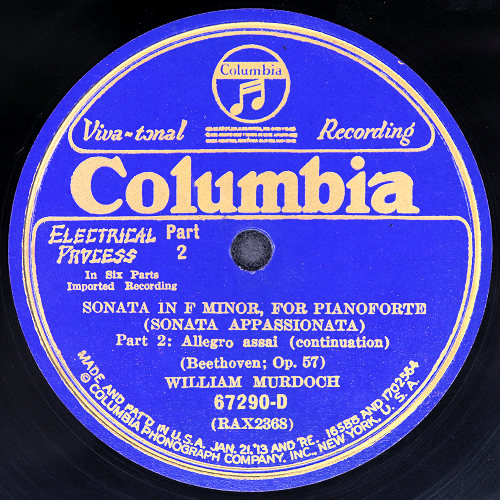 |
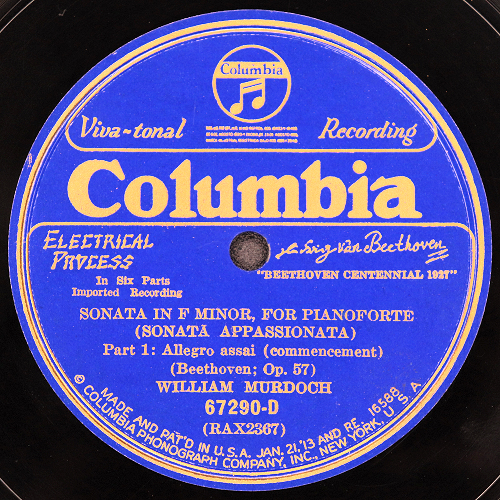
| Appassionata Sonata: Part 1: Allegro assai (commencement) | Appassionata Sonata: Part 2: Allegro assai (continuation) |
| William Murdoch | William Murdoch |
| Columbia 67290-D | Columbia 67290-D |
| Matrix# RAX2367 4-A-5, Take 4 | Matrix# RAX2368 2-A-5, Take 2 |
| January 19, 1927 | January 19, 1927 |
| Wigmore Hall, London | Wigmore Hall, London |
 |
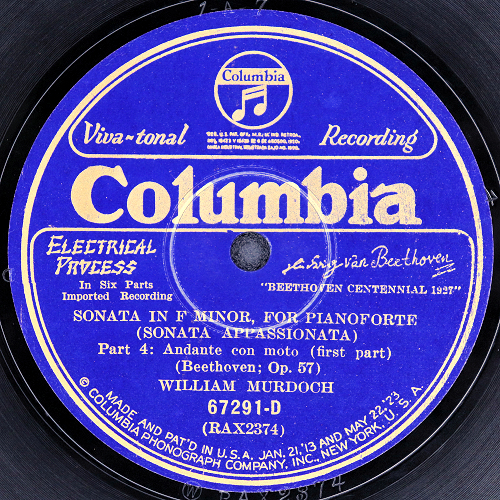 |
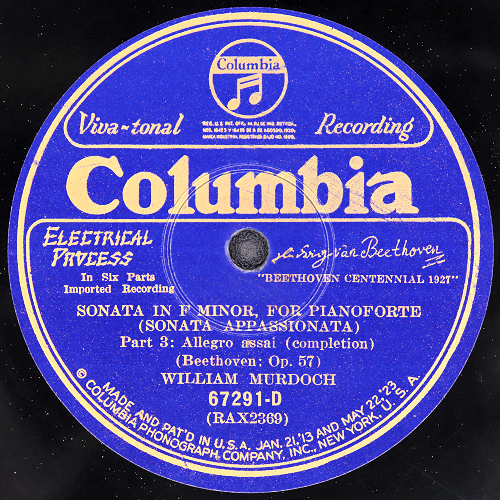
| Appassionata Sonata: Part 3: Allegro assai (completion) | Appassionata Sonata: Part 4: Andante con moto (first part) |
| William Murdoch | William Murdoch |
| Columbia 67291-D | Columbia 67291-D |
| Matrix# RAX2369 4-A-4, Take 4 | Matrix# RAX2374 1-A-7, Take 1 |
| January 19, 1927 | January 20, 1927 |
| Wigmore Hall, London | Wigmore Hall, London |
 |
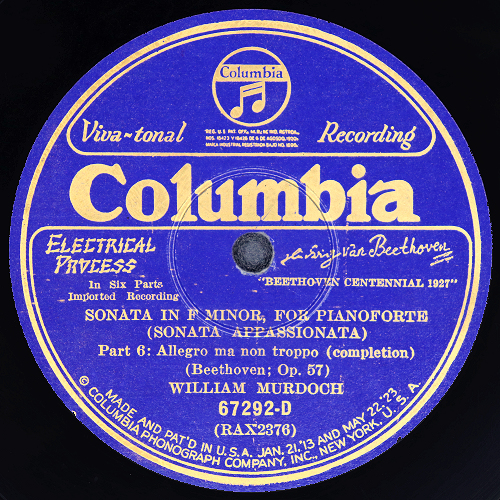 |
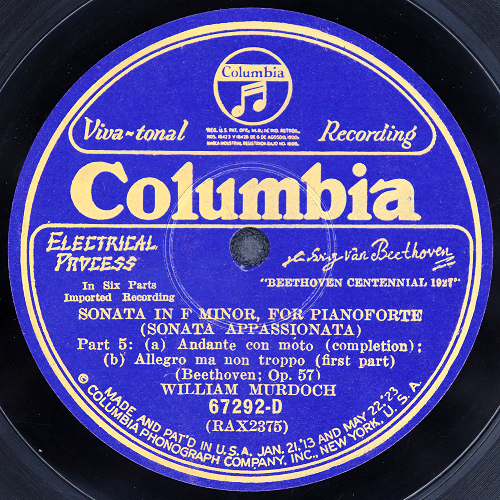
| Appassionata Sonata: Part 5: (a) Andante con moto (completion) (b) Allegro ma non troppo (first part) | Appassionata Sonata: Part 6: Allegro ma non troppo (completion) |
| William Murdoch | William Murdoch |
| Columbia 67292-D | Columbia 67292-D |
| Matrix# RAX2375 1-A-1, Take 1 | Matrix# RAX2376 1-A-1, Take 1 |
| January 20, 1927 | January 20, 1927 |
| Wigmore Hall, London | Wigmore Hall, London |